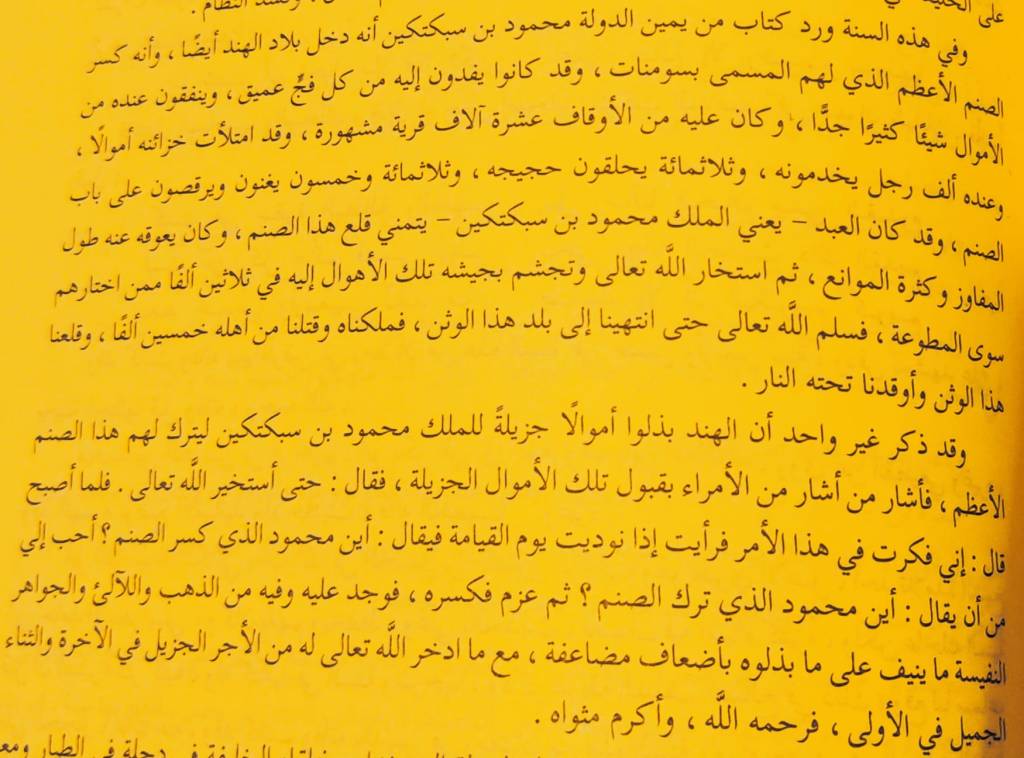
Sultān Mahmūd al-Ghaznavi رحمه الله (D. 421 AH) was known as كسر الصنم (The Idol Breaker). He invaded India 17 times and he was victorious 17 times! He was an Athari ruler, originally from Ghazni in Afghanistan. He was formerly upon the Hanafi Madhab in Fiqh then he left this Madhab due to his love for Hadeeth and its people, after a debate in his courtyard as mentioned by the historian Ibn Khallikān. Imām Ibn Katheer رحمه الله reports: “The Historians have mentioned that the Hindus offered Mahmūd a large amount of Gold and various treasures in an effort to stop him breaking one of their biggest idols the temple of “Somnath”. Some of his advisors told him to take The sum and leave the idol. Mahmūd said: “Let me pray Salat al-Istikhārah and I will see!” When the morning came he said: “I have thought about the matter! I have seen that I would love to be called on the day of Judgment as – “Where is Mahmūd the idol breaker! Rather than be called – “Where is the one who left an idol (for the world)!?” Then he destroyed it. And he also slayed 50,000 Hindus who tried to protect their idol. May Allāh have mercy on him.” [Al-Bidaya wa-Nihāya vol 6: under the events that occurred in 418 AH]
Shaykh Ibn Uthaymeen رحمه الله also praised this noble ruler in his Sharh al-Tadmuriyyah and in his other lessons, whereby Shaykh Ibn Uthaymeen mentioned his great service to Islam and the great Munazara (debate) that took place between him (Sultān Mahmūd al-Ghaznavi) رحمه الله and the deviant Abu Bakr Ibn Furāk (d. 406 AH) who was the Imām of the Ashā’irah. When Ibn Furāk entered into the courtyard of Mahmūd al-Ghaznavi, he argued that Allāh is not above, nor is He in any other location or direction. Mahmūd al-Ghaznavi responded to him by saying “You argue that your Lord is non-existent!” and thereafter it is mentioned by historians that he executed Ibn Furāk. Mahmūd al-Ghaznavi رحمه الله was a noble ruler who dealt with the Mushrikūn Hindus and the Ashā’irah Nufāt.
Imām adh-Dhahabi رحمه الله stated in his work, Siyār A’lām an-Nubalā, that Ibn Furāk, who was an Imām of the Ash’arīyyah, entered upon the ruler Mahmūd Ibn Sabkatkin (421 AH) and said to him: “It is not allowed to describe Allāh as being above (Fawqiyyah) because that would necessitate describing Him [also] with being below…” So the ruler said: “It is not me who described Allāh [being above] such that I am necessitated [by your assertion]. Rather, it is He (Allāh) who has described Himself [being above].” So, Ibn Furāk was dumbfounded, unable to respond.
Imām Ibn Hazm رحمه الله mentions that Ibn Furāk al-Asharī was executed by the ruler Sultān Mahmūd al-Ghaznavi for his Kufrī statement that the Messenger of Allāh ﷺ was only a Messenger whilst he was alive.
[4/162 الفصل في الملل والأهواء والنحل]

 AhlulHadeethPublications.Com