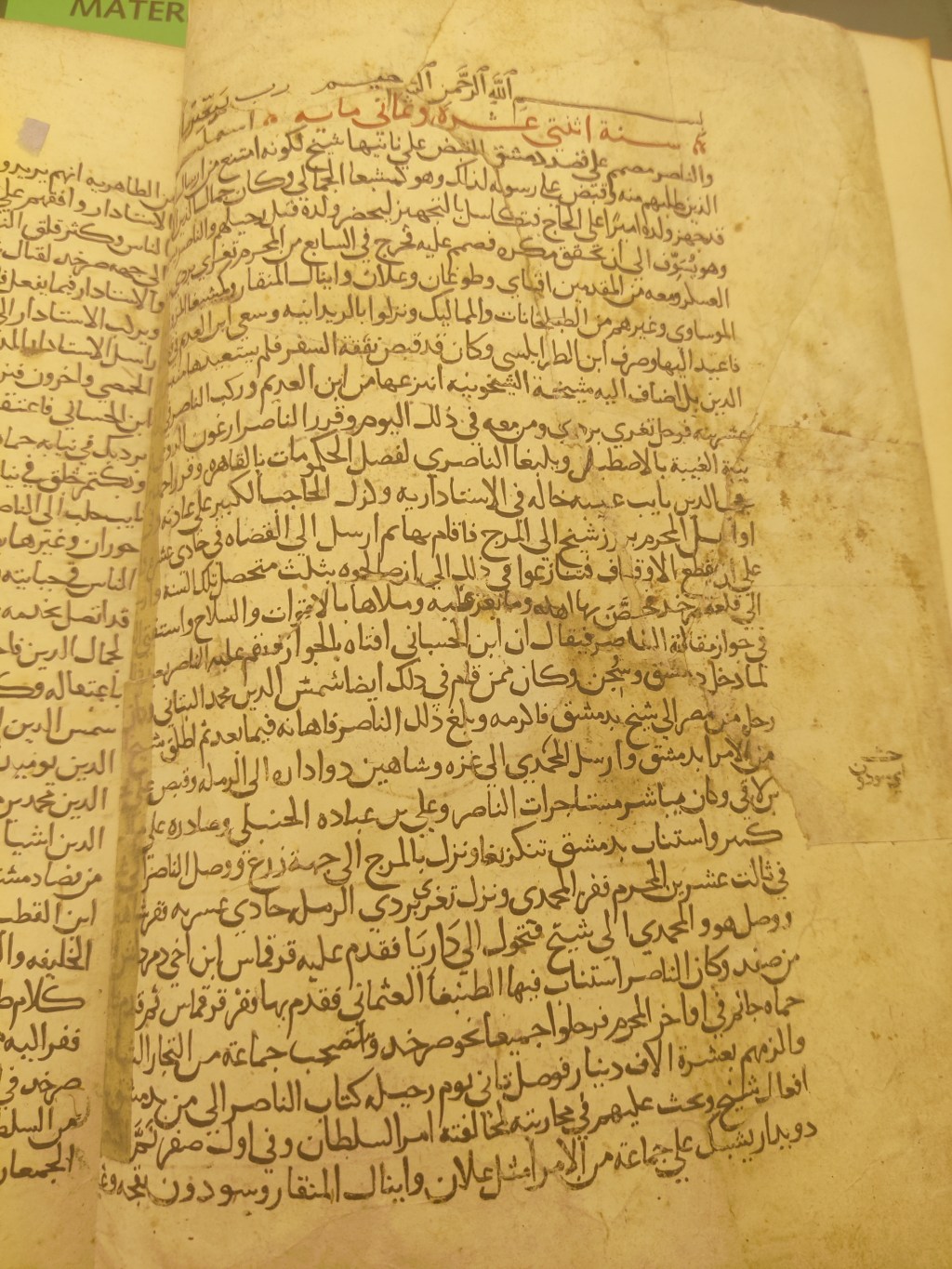
Exploring the manuscript:
Inbā’ al-Ghumar bi Abnā’ al-‘Umr by Imām Ibn Hajr al-Asqalānī رحمه الله
إنباء الغمر بأبناء العمر للإمام ابن حجر العسقلاني
This book is a historical masterpiece written by the great Imām Ibn Hajr al-Asqalānī [d. 852 AH]. In the Muqadimmah (introduction) of this book, titled “إنباء” Ibn Hajr himself stated that he had composed a history book. The manuscript discovered in the British Library contains handwriting attributed to his senior student Qutb ad-Deen Muhammad al-Khaydharī. This stands as a testimony to the fact that Imām Ibn Hajr was not only a scholar in Hadeeth but also a scholar in Tāreekh (history), as this book is regarded as a historical encyclopedia akin to Al Bidayah wa An-Nihāyah by Imām Ibn Katheer. This is in contrast to the misconception held by some that it is a book which merely contains Siyār (biographies). However, this notion couldn’t be further from the truth. The work primarily centers on dates and the years in which pivotal historical events transpired, serving as chapter headings. It commences from the year 773 AH and extends until the year 850 AH. Thus, this book is seen as a continuation of Ibn Katheer’s Al Bidayah wa An-Nihāyah, which concludes at the year 768 AH.
It is noteworthy that Ibn Hajr emulated the methodology of his Shaykh (Ibn Katheer) throughout Inbā’ al-Ghumar, by citing the year of events as the title for each chapter heading. The work is presented in the form of a chronicle, meticulously detailing and summarizing key occurrences in Egypt, the Levant & the wider Muslim world during Ibn Hajr’s era. Imām Ibn Hajr was praised as a Hujjah (authority) in history for his work focusing on the Mamluks. Thus he was cited as a credible source within al-Tabaqāt as-Shafi’īyyah and similarly by as-Sakhāwī. Furthermore, Ibn Hajr also relied upon the works of Imām ad-Dhahabi and Ibn Muflih as sources and reference points whilst compiling this historical compendium.
This particular Nuskhah (manuscript), attributed to the handwriting of Qutb ad-Deen Muhammad al-Khaydharī, is inscribed in black ink. It is recorded in historical accounts that Ibn Hajr left 10 Dinars for his student al-Khaydharī in his will. Al-Khaydharī sat under Ibn Hajr’s tutelage for numerous years, seeking knowledge.
•Researched & compiled by Abu Sakeenah Abdur Razaq al-Athari
•5 Safar 1445 AH/21 August 2023

 AhlulHadeethPublications.Com
Leave a comment